Why Do I Need O-PEN®?
Understanding the hidden danger in PME earthing systems, and why BS 7671:2018 Amendment 2 now mandates additional protection for outdoor EV charge points.
What is a PEN Conductor Fault?
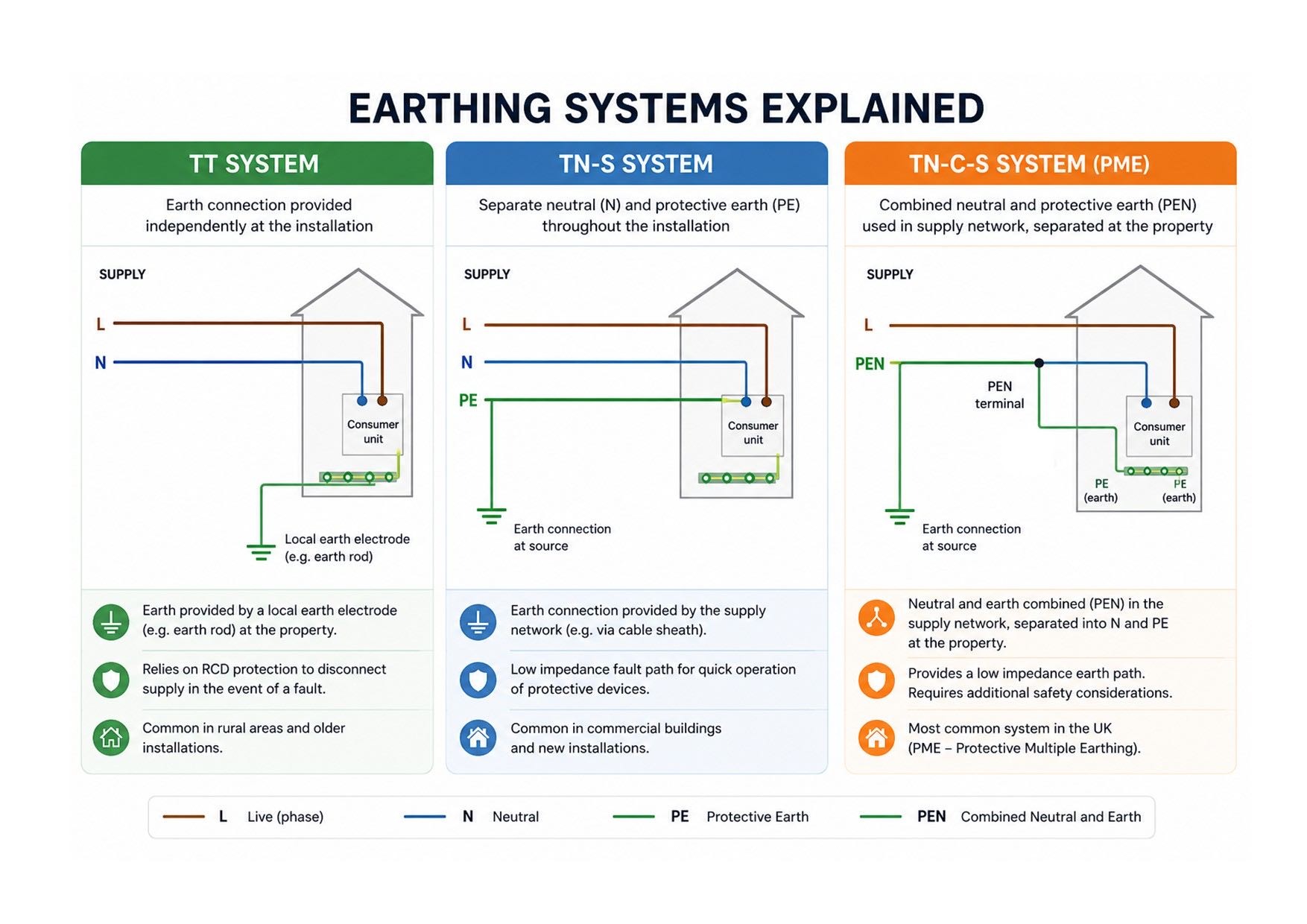
Most UK homes and businesses are connected to a PME (Protective Multiple Earthing) or TN-C-S earthing system. In this arrangement, the neutral and protective earth conductors are combined into a single conductor, known as the PEN (Protective Earth Neutral) conductor, in the distribution network.
Under normal conditions, this works perfectly well. However, if the PEN conductor is damaged or broken at any point between the electricity substation and your property, something extremely dangerous can happen.
The Danger: Voltage Appears on All Metalwork
When the PEN conductor breaks, the return path for current is lost. The neutral voltage rises and this voltage appears on every metallic surface connected to the earthing system, including EV charge point cases, enclosures, and any other bonded metalwork. This creates a lethal shock risk that a person may not be able to avoid.
The critical issue is that standard MCBs and RCDs offer absolutely no protection against this fault. Because both live and neutral/earth are at the same elevated voltage, no imbalance is created, so RCDs don't trip and MCBs see no overcurrent. The hazard is completely invisible to conventional protective devices.
Why is This Especially Relevant to EV Charging?
Outdoor Equipment
EV charge points are installed outdoors, where a person standing on wet ground and touching the charger case creates a direct path to earth, amplifying the shock risk.
High Power Circuits
EV chargers operate on high-power circuits (7kW+), meaning higher voltages and currents are involved compared to typical domestic appliances.
Wet Conditions
Cars, driveways, and car parks are regularly wet, which significantly reduces the body's resistance and makes even lower touch voltages potentially fatal.
Direct Connection
The physical connection between a person and the vehicle/charger during a charging session creates multiple potential shock paths.
Earthing System Types
What Does BS 7671 Require?
BS 7671:2018 Amendment 2:2022, Regulation 722.411.4.1
PME earthing cannot be used for the connection of outdoor charging points unless specific protective measures are implemented to prevent dangerous touch voltages exceeding 70V RMS in the event of a PEN conductor failure.
Since the introduction of Amendment 2 in 2022, all new EV charge point installations on PME supplies must include protection against the PEN fault scenario. This applies to both commercial and domestic installations.
There are three recognised approaches in the regulation. matt:e's O-PEN® technology covers all three without requiring traditional earth electrode installations, avoiding the groundworks cost entirely.
Commercial: Three-Phase
For three-phase PME installations, covered by our Commercial EV connection centres.
Domestic: Single-Phase
For single-phase PME installations, covered by our Domestic EV units.
Site-Wide Protection
For comprehensive building-level monitoring and protection, covered by the Guardian system.
How O-PEN® Solves It
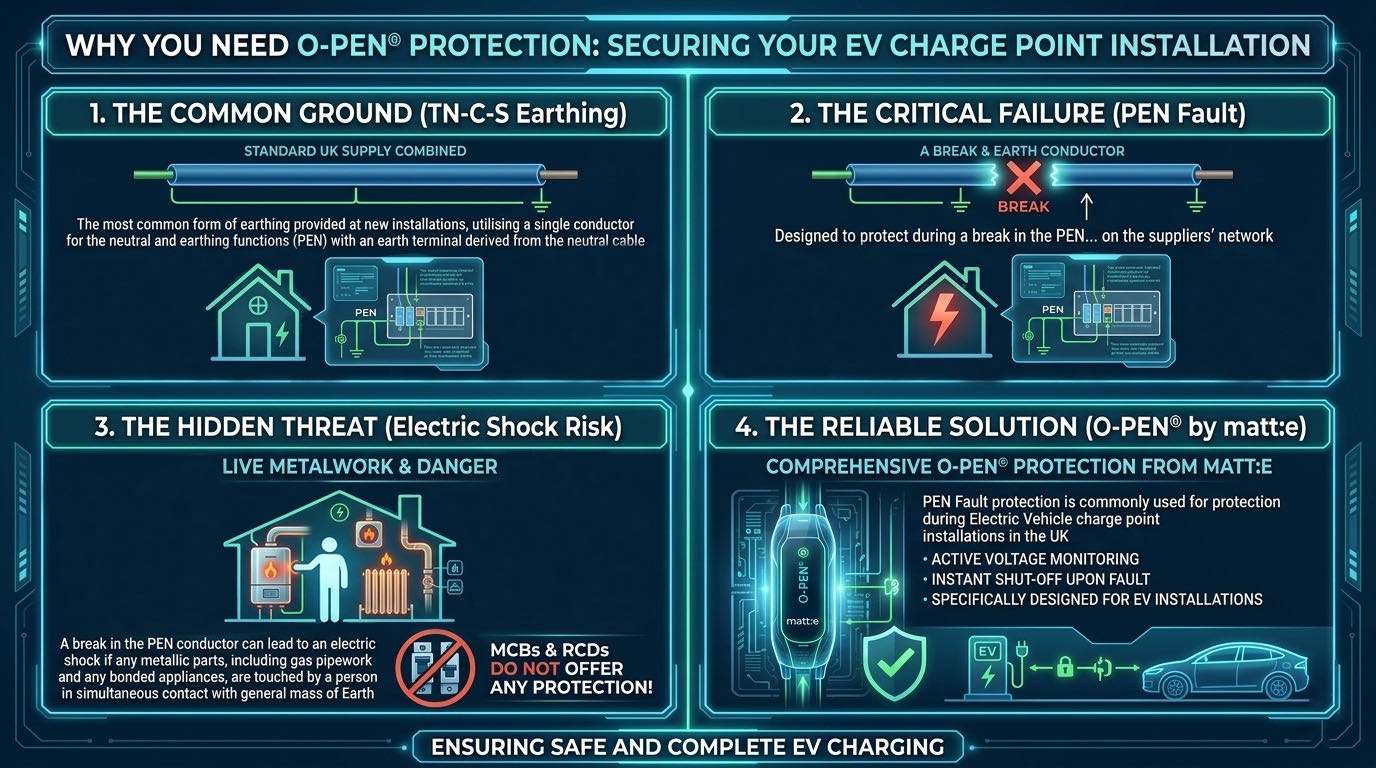
Rather than relying on voltage assumptions, O-PEN® establishes a zero-point reference from the three-phase supply to directly measure actual touch voltages. This approach:
Detects a broken PEN conductor before touch voltages become dangerous
Disconnects all poles (including the circuit protective conductor) within 5 seconds
Significantly reduces false trips during normal supply variations
Requires no earth electrodes, eliminating costly and disruptive groundworks
Maintains consistent protection regardless of seasonal soil resistance changes
Still have questions?
Our technical team can explain exactly which O-PEN® product is right for your specific installation scenario.